In the comment sections below, find the category for which each of your topics belong. Click the reply button and post your argument(s) there. For this part of the assignment, you will follow the format we discussed in class (and what you have been given in handouts). Be sure to include your sources (cited in APA) either as footnotes or with each scientific/factual claim. Remember, you need to complete 3 arguments.
Your arguments need to be posted by October 24, 2013.
Wednesday, October 16, 2013

Thursday, October 3, 2013
Arsenicals in Chicken
A study by John Hopkins University has shown that there is a significant amount of arsenic used when farm raising chicken. Arsenic is used to promote growth, treat disease, and improve meat pigmentation in chicken. However, arsenic is a known toxin and carcinogen. When farmers feed arsenicals to their chickens, it will stay in their muscles, which means that we will consume an unsafe amount of arsenic. This means that we have an increased chance of cancer, diarrhea, vomiting, hair loss, and convulsions, and heart disease.
Since arsenic poses a serious threat to human health, steps must be taken to resolve this issue. The FDA can to change their regulation, much like Europe has already done. On a more personal level, we can choose to avoid meat which has been raised by a company known for feeding arsenicals. Education can also help prevent health consequences. If we educate our friends and family on the harms of arsenic and its presence in chicken, companies and the FDA can take note and alter business practices/regulations.
Since arsenic poses a serious threat to human health, steps must be taken to resolve this issue. The FDA can to change their regulation, much like Europe has already done. On a more personal level, we can choose to avoid meat which has been raised by a company known for feeding arsenicals. Education can also help prevent health consequences. If we educate our friends and family on the harms of arsenic and its presence in chicken, companies and the FDA can take note and alter business practices/regulations.
What's Really in Our Sports Drinks? (Brominated Vegetable Oil)
Brominated Vegetable Oil (BVO), created by bonding vegetable oil to the element bromine, is a food additive put in sports drinks and sodas to keep the citrus flavoring from separating from the rest of the drink. It's present in drinks such as Powerade, Mountain Dew, Fanta, and has recently been eliminated from Gatorade. Although the added ingredient has been banned in over 100 places such as Europe and Japan, it still remains a legal and commonly consumed food item in the United States today.
 So what's the problem with Brominated vegetable oil? First, BVO contains bromine, which is an element commonly used in flame retardant materials which are known to cause problems in brain development, fertility and possibly even cancer. When drinking BVO, over a period of time, the substance can build up in the body and cause toxic effects, leading to issues such as memory loss, loss of coordination, and skin conditions like sores and halogen acne.
Now what is the next course of action? Well, recently the FDA changed BVO's safety status from "generally considered safe" to "questionable." Hopefully, this change will lead to more studies being performed on the harmful effects of the substance, and maybe eventually lead to a ban altogether. Until then, however, I recommend looking at the ingredient list of the juices and sodas you drink, or better yet, avoid drinking extremely processed liquids altogether.
For more information, go to one or more of these websites:

Now what is the next course of action? Well, recently the FDA changed BVO's safety status from "generally considered safe" to "questionable." Hopefully, this change will lead to more studies being performed on the harmful effects of the substance, and maybe eventually lead to a ban altogether. Until then, however, I recommend looking at the ingredient list of the juices and sodas you drink, or better yet, avoid drinking extremely processed liquids altogether.
 |
| An illustration depicting the dangers of drinks containing BVO |
For more information, go to one or more of these websites:
rBST/rBGH
Two growth hormones, rBGH and rBST, are routinely given to U.S. dairy cows to increase milk production. However, controversy, both about the health of the animals and about the health of human consumers of their milk, has followed their use ever since their introduction in the 1980s. The European Union, Canada, Australia, New Zealand, Japan, and Israel have all disallowed use of the hormone, but as of 1993 it has been officially approved by the Food and Drug Administration of the United States.
Animal health concerns are certainly valid, as several analyses show that the hormones decrease fertility by 40%, increase the risk of mastitis, and increase the risk of lameness by 55%. Due to these problems, rBST treated cows are usually also administered more antibiotics, which can possibly leech into the milk and also increase the likelihood of development of super strains. Thus, it is conclusive that the drug causes animal health problems and decreases animal welfare.
Also concerning are possible human health impacts from the chemicals. Chemical analyses of the non rBST milk and rBST milk have shown that milk from hormone-treated cows has slightly elevated levels of BST. These hormones have however been shown to have no real effect on humans, and additionally if milk contains antibiotics as mentioned in the previous paragraph, it cannot be legally sold. What is concerning is IGF-1, which can also be increased in quantity by use of rBST/rBGH. This chemical has probable relationships to some tumors, as confirmed by the American Cancer Society, though how much is absorbed into the body through consumption of food is unclear.
I feel that rBGH (whose use has been decreased significantly already by consumer pressures -- one of the few times this has ever happened) should be bannned as it is in the European Union, not only because of the possible human health risks which are as of yet uninvestigated by our terrible excuse for a food safety administration, but also because of the typically unconsidered animal welfare concerns. If we must use (and abuse) animals for our own purposes, we should at least ensure that they are cared for properly, and rBST/rBGH is certainly not proper care, and so we should say no to possible cancer and no to definite cruelty for a slight increase in profit.
http://www.cmaj.ca/content/161/6/677.full
http://en.wikipedia.org/wiki/RBGH
http://awionline.org/content-types-orchid-legacy/awi-quarterly/rbgh-reconsidered
Animal health concerns are certainly valid, as several analyses show that the hormones decrease fertility by 40%, increase the risk of mastitis, and increase the risk of lameness by 55%. Due to these problems, rBST treated cows are usually also administered more antibiotics, which can possibly leech into the milk and also increase the likelihood of development of super strains. Thus, it is conclusive that the drug causes animal health problems and decreases animal welfare.
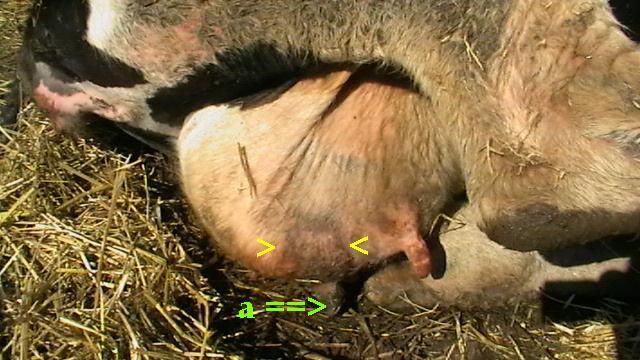 |
| A gangrenous udder for you to look at. |
Also concerning are possible human health impacts from the chemicals. Chemical analyses of the non rBST milk and rBST milk have shown that milk from hormone-treated cows has slightly elevated levels of BST. These hormones have however been shown to have no real effect on humans, and additionally if milk contains antibiotics as mentioned in the previous paragraph, it cannot be legally sold. What is concerning is IGF-1, which can also be increased in quantity by use of rBST/rBGH. This chemical has probable relationships to some tumors, as confirmed by the American Cancer Society, though how much is absorbed into the body through consumption of food is unclear.
I feel that rBGH (whose use has been decreased significantly already by consumer pressures -- one of the few times this has ever happened) should be bannned as it is in the European Union, not only because of the possible human health risks which are as of yet uninvestigated by our terrible excuse for a food safety administration, but also because of the typically unconsidered animal welfare concerns. If we must use (and abuse) animals for our own purposes, we should at least ensure that they are cared for properly, and rBST/rBGH is certainly not proper care, and so we should say no to possible cancer and no to definite cruelty for a slight increase in profit.
http://www.cmaj.ca/content/161/6/677.full
http://en.wikipedia.org/wiki/RBGH
http://awionline.org/content-types-orchid-legacy/awi-quarterly/rbgh-reconsidered
rBGH and rBST hormones
Growth hormones called rBGH and rBST are given to cows in
order to increase the amount of milk they produce. Studies show that one out of
every six dairy cows in the United States is injected with these hormones over
and over again. Most of the antibiotics used in the United States are for
animals to keep them healthy. However, there are some concerns arising about
the safety of these hormones. Some of the negative effects to this hormone are
that connections have been found linking the milk produced from cows injected
with these hormones and cancers being found such as breast, colorectal, and
prostate. Although these hormones are not banned in the United States, it is in
other countries such as Australia, New Zealand, Israel, EU, and Canada. There
are many people in the United States who are against farmers using these
hormones in their cows in fear of some of the negative effects they have as
stated above. Some milk companies have started to label their milk as having no
added hormones to ensure the customers that no rBGH or rBST are present in
their milk/dairy products. Places such as Starbucks, Wal-Mart, Kroger, etc.
have stopped using and/or milk products that contain these hormones. In the
future, I personally hope that these hormones are banned in the United States
from being injected into cows. I think for right now, more studies and
experiments need to be conducted to find how harmful these hormones truly are
to consumers buying milk with the hormones included. For more information check out this link.
“rBGH.” Grace
Communications Foundations. N.p., n.d. Web. 3 Oct. 2013.
Farmed-Raised Salmon
I have chosen to discuss farm-raised salmon and its "wonderful" qualities. Wild salmon has a famous pinkish-orange color to it, which they obtain through their diet. When salmon are raised on farms, they do not always get the same diet to recieve their pinkish-orange color, so the farmers feed the salmon canthaxanthin to give them there natural color.
So what is wrong with that? The farmers are just trying to give the people what they want. Well, the problem is that canthaxanthin is that it is known to cause problems within the retina resulting in possible vision damage. It has been banned in both Austialia and New Zealand. I do not ulndertand why the United States would allow canthaxanthin in foods, when it can cause eyesight damage and cancer. It is already suggested not to eat a great amount of fish too regulary, so we should not increase the risk.
Now, it is highly recommended to eat wild salmon more than farm-raised salmon because of safety. I do feel like food should be colored with chemicals just because that is the color it should be. If you want your meat to look like it is suppose to, then feed your fish the correct diet to give it its pinkish-orange. Do not skip corners and cheat. Also, the U.S. needs to ban more things that are currently allowed to be put in the food we eat.
http://www.albany.edu/ihe/salmonstudy/
So what is wrong with that? The farmers are just trying to give the people what they want. Well, the problem is that canthaxanthin is that it is known to cause problems within the retina resulting in possible vision damage. It has been banned in both Austialia and New Zealand. I do not ulndertand why the United States would allow canthaxanthin in foods, when it can cause eyesight damage and cancer. It is already suggested not to eat a great amount of fish too regulary, so we should not increase the risk.
Now, it is highly recommended to eat wild salmon more than farm-raised salmon because of safety. I do feel like food should be colored with chemicals just because that is the color it should be. If you want your meat to look like it is suppose to, then feed your fish the correct diet to give it its pinkish-orange. Do not skip corners and cheat. Also, the U.S. needs to ban more things that are currently allowed to be put in the food we eat.
http://www.albany.edu/ihe/salmonstudy/
Potassium Bromate and Its Effects
Potassium
Bromate is an ingredient added to breads to help the dough hold together and
rise higher. After the goods are baked, Potassium Bromate, or KBrO3, is a white, powdery substance. It is consumed almost daily by Americans
across the nation with most likely no idea that their bread may contain a serious
health risking additive. After many extensive studies, very similar conclusions have been made
about Potassium Bromate and its effect on the human body. Bromate was first found to cause tumors in rats during a
study in 1982. During these trials on rats and mice, it was confirmed that the
use of KBrO3 causes
tumors of the kidney, thyroid, and in other organs. (http://www.cspinet.org/new/bromate.html). These effects aren’t found only in rats or mice, but also
impact human life. KBrO3 induces
mutations, alters gene expression, leading to cancer (http://www.biomedcentral.com/1472-6882/12/204). Even with the International Agency for Research on Cancer stating that
potassium bromate is possibly cancerous to humans, it has not been banned in the
United States. Bakery’s goal is to bake the potassium bromate out of the goods,
but this is not necessarily always happening. Therefore, with tests done and
data gathered showing the potential for negative results, the FDA should make
regulations to ensure the Potassium Bromate is in no danger to the people.
Another
great source to look at for more information is http://www.ncbi.nlm.nih.gov/pmc/articles/PMC1567851/. It includes all of the side effects on KBrO3.
Amanda Dotson
Banned Foods: Olestra/Olean
After reading through the astounding list of foods and
additives that are allowed to be used in many of the foods that Americans
consume each day, the one that caught my attention the most was a fake fat
substitute called Olestra/Olean. Most
commonly known by its brand name, Olean, this fat substitute has been found in
numerous high-fat foods, such as potato chips (specifically including Frito-Lay’s
Light chips and Procter & Gamble’s Pringles brand chips), and fast-food
fries. Although Olean does not add fat, calories, or cholesterol to its
products, there are still many evident concerns about its negative
side-effects.
So what is the problem with adding
Olean to one’s dietary menu? Well, as part of a study conducted by Purdue
University in 2011 that fed rats with potato chips containing Olean, the results
showed that the rats gained significant weight. Also, several reports have
proven adverse intestinal side-affects to Olean, including diarrhea, cramps,
and leaky bowls. However, the main problem with adding Olean as a fat
substitute into one’s diet is the fact that it interferes with the absorption
of fat soluble vitamins such as A, D, E, and K. The scariest part about this
knowledge, though, is that since 1996 the Food and Drug Administration (FDA) has
allowed products with Olestra to be made in the United States as long as these
vitamins are added to such products after being processed.
Now that Olestra/Olean has been
proven as a harmful fat substitute found in many of the foods eaten by individuals
throughout the nation, what is the next step of action? Looking at other
countries around the world aware of this information, both the United Kingdom
(UK) and Canada have actually banned this fake fat substitute from their food
products. As a concerned citizen living in the United States, and someone who eats food
products that contain Olestra/Olean, I advocate the removal of this additive
from the American diet as well.
For a list of common food products
that contain Olestra/Olean or for more information about this additive, click
on the link below:

Wednesday, October 2, 2013
Using Poison to Fake Chicken Health
There are many known food additives or components of the food production process that have been banned around the world. One of these components, arsenic, is used in order to cut the corners of chicken production. Arsenic is fed to chickens raised in the United States in order to increase their weight and consequently require the use of less chicken feed. Although arsenic is helpful in preventing parasite-infested poultry, its questionable qualities lead one to wonder if the element is really worth using. Despite arsenic's capability to make chicken appear healthier and more aesthetically pleasing, the element is known for being "notoriously poisonous" and a dangerous carcinogen (1).
The use of arsenic in food production has been strictly banned by the European Union - and for good reason. Millions of people around the world are endangered by groundwater that has been contaminated by arsenic; many suffer from long-term damage (including cancer) after being exposed to the horrible poison (2). After recognizing the treacherous effects of arsenic I cannot help but wonder why the United States still permits the use of this element in our food. Exposure to arsenic contamination in water can result in effects such as this:
 so why in the world would the FDA allow it to be intentionally injected into a primary American food source (3)?
I sincerely hope that the FDA can come to its senses and acknowledge that our nation is quite literally being poisoned one chicken at a time. I haven't ever considered being a vegetarian, but if arsenic continues to be an integral part of the poultry-raising process, I might have to think twice next time I go to Food Lion.
(1) For more on how arsenic is used in the U.S.: http://healthyliving.msn.com/health-wellness/10-things-americans-eat-that-are-banned-elsewhere#6
(2) For more on the long-term effects and background of arsenic: http://en.wikipedia.org/wiki/Arsenic
(3) For the grotesque picture: http://insidecostarica.com/2013/04/19/arsenic-in-guanacaste-water-supplies-constitutional-court-puts-pressure-on-chinchilla-to-act/
The use of arsenic in food production has been strictly banned by the European Union - and for good reason. Millions of people around the world are endangered by groundwater that has been contaminated by arsenic; many suffer from long-term damage (including cancer) after being exposed to the horrible poison (2). After recognizing the treacherous effects of arsenic I cannot help but wonder why the United States still permits the use of this element in our food. Exposure to arsenic contamination in water can result in effects such as this:

I sincerely hope that the FDA can come to its senses and acknowledge that our nation is quite literally being poisoned one chicken at a time. I haven't ever considered being a vegetarian, but if arsenic continues to be an integral part of the poultry-raising process, I might have to think twice next time I go to Food Lion.
(1) For more on how arsenic is used in the U.S.: http://healthyliving.msn.com/health-wellness/10-things-americans-eat-that-are-banned-elsewhere#6
(2) For more on the long-term effects and background of arsenic: http://en.wikipedia.org/wiki/Arsenic
(3) For the grotesque picture: http://insidecostarica.com/2013/04/19/arsenic-in-guanacaste-water-supplies-constitutional-court-puts-pressure-on-chinchilla-to-act/
Banned Foods: Potassium Bromate
Potassium Bromate is one prime example of an additive that is allowed in the United States, but is banned in other countries. Places such as China, Canada, and the European Union have prohibited potassium bromate for many reasons. For example, studies have shown that this additive in particular has been linked to help cause kidney damage, tumors, cancer, as well as damage to the nervous system. Any "normal" human being would suspect that for these reasons alone, most people would not use this additive. However, America continues on using potassium bromate as just another step in their process of making the bread that is sold throughout their country. The United States' reasoning for using such an additive is that it holds the dough together, while also making it easier for the bread to rise to a higher level than normal. America's main goal is to make sure that most of the potassium bromate cooks out of the bread as the dough bakes; however, not all of it does, and any amount that is ingested can be harmful to the human body. Although it may seem a bit surreal that a country could ignore the fact that the health of their citizens is now more endangered, it still happens. So as an American citizen, does that mean that we can still rely on and trust the F.D.A. if they have yet to band something that is so dangerous for humans to have? One would suspect not.
I know that to me this becomes personal when I think back to how I lost my best pal, Ally the dog, to kidney failure. You never really think that something like that could happen until it does. With that being said, it actually makes me a bit upset that our own F.D.A. would play around with such a serious condition; allowing such an additive to be placed in our food. In all, it makes me a bit ashamed that I have eaten the bread from my local grocery-store.
To find out more about how potassium bromate is being used in bread within the U.S., click on the following link.: http://www.kingarthurflour.com/professional/bromate.html
I know that to me this becomes personal when I think back to how I lost my best pal, Ally the dog, to kidney failure. You never really think that something like that could happen until it does. With that being said, it actually makes me a bit upset that our own F.D.A. would play around with such a serious condition; allowing such an additive to be placed in our food. In all, it makes me a bit ashamed that I have eaten the bread from my local grocery-store.
To find out more about how potassium bromate is being used in bread within the U.S., click on the following link.: http://www.kingarthurflour.com/professional/bromate.html
Tasting the Rainbow May Be Bad For You
I have chosen to discuss the harmful effects that food coloring and dyes pose for consumers because I think it's safe to assume that most people have eaten something with red 40, yellow 5, yellow 6 and/or blue 2 at some point within the last year. These food colors and dyes can be found in common foods that many consume everyday such as Kraft foods, children's cereals, sports drinks, or candies. The problem with these colorful effects is that many children have developed allergies from the dyes and some contain carcinogens. Carcinogens damage DNA, which can eventually lead to cancer. With more and more individuals eating processed foods that contain food coloring everyday, the risk of Americans who can get cancer keeps increasing. Studies conducted by the Center for Science in the Public Interest (CSPI) have linked ADHD to these same food colorings and dyes.
What is interesting is that although these dyes have been banned in countries like Norway and Austria, the FDA has not yet made any such laws that prohibited companies from using dyes. In order for Kraft to sell their products in these countries they must add natural food coloring by using ingredients like paprika extract, beetroot, and annatto. Kraft and other companies should begin incorporating more natural food colors into their products. Although this may cost more to make, the cost can be made up in the price of the product because anything "natural" or "organic" is typically more expensive anyways. As a consumer, I would be willing to pay more for my favorite thing in the world, Mac n' Cheese, if I knew I was protecting myself from the harmful effects in the long run. I would hate to suffer from Cancer all because Kraft wanted their cheddar sauce to appear orange.
ADHD source: http://www.foodsafetynews.com/2010/07/popular-food-dyes-linked-to-cancer-adhd-and-allergies/#.UkyojdKsiSo
Information on Carcinogens: http://www.cancerresearchuk.org/cancer-info/cancerandresearch/all-about-cancer/what-is-cancer/what--cancer/what-causes-cancer2#Carcinogens
What is interesting is that although these dyes have been banned in countries like Norway and Austria, the FDA has not yet made any such laws that prohibited companies from using dyes. In order for Kraft to sell their products in these countries they must add natural food coloring by using ingredients like paprika extract, beetroot, and annatto. Kraft and other companies should begin incorporating more natural food colors into their products. Although this may cost more to make, the cost can be made up in the price of the product because anything "natural" or "organic" is typically more expensive anyways. As a consumer, I would be willing to pay more for my favorite thing in the world, Mac n' Cheese, if I knew I was protecting myself from the harmful effects in the long run. I would hate to suffer from Cancer all because Kraft wanted their cheddar sauce to appear orange.
ADHD source: http://www.foodsafetynews.com/2010/07/popular-food-dyes-linked-to-cancer-adhd-and-allergies/#.UkyojdKsiSo
Information on Carcinogens: http://www.cancerresearchuk.org/cancer-info/cancerandresearch/all-about-cancer/what-is-cancer/what--cancer/what-causes-cancer2#Carcinogens
Colors and dyes
Red 40, yellow 5, yellow 6, and blue 2 are some very common food colors and dyes that are found in many quick American foods such as fruits, chips, and yogurt. The colors and dyes are also found in lip moisturizer, shampoo, and some vitamins. There isn't a day in a regular American's life when they don't come into contact with these colors and dyes.
They debate on whether they are harmful or not has been going on in America for years, but in other countries such as Australia and Norway, they have been banned. Even Britain urges the companies not to use the colors and dyes. This is because of the fact that there are harmful toxins, carcinogens, and contributors to ADHD. The reason it is still legal in the USA is because there are other unnatural chemicals in most of the foods and health-care products that use colors and dyes, so determining the cause of health problems is tricky. If there are health problems associated with the health-care products and foods, it is almost impossible to link those problems back to the colors and dyes solely.
A way that companies can change the colors and dyes they use in their foods is to use natural resources to color their products. "... food makers like Kellogg's tint food distributed outside the U.S. with paprika extract, beetroot, annatto and other color additives thought to be much safer than the dyes used in the U.S." (msn, Colors and Dyes). This would be more expensive for the companies and the color might not be as vivid with the natural additives than with the dyes, but that's a price I would be willing to pay for the knowledge that there are no harmful dyes in my mac 'n cheese and shampoo.
http://www.forbes.com/sites/rachelhennessey/2012/08/27/living-in-color-the-potential-dangers-of-artificial-dyes/
http://healthyliving.msn.com/health-wellness/10-things-americans-eat-that-are-banned-elsewhere#7
They debate on whether they are harmful or not has been going on in America for years, but in other countries such as Australia and Norway, they have been banned. Even Britain urges the companies not to use the colors and dyes. This is because of the fact that there are harmful toxins, carcinogens, and contributors to ADHD. The reason it is still legal in the USA is because there are other unnatural chemicals in most of the foods and health-care products that use colors and dyes, so determining the cause of health problems is tricky. If there are health problems associated with the health-care products and foods, it is almost impossible to link those problems back to the colors and dyes solely.
A way that companies can change the colors and dyes they use in their foods is to use natural resources to color their products. "... food makers like Kellogg's tint food distributed outside the U.S. with paprika extract, beetroot, annatto and other color additives thought to be much safer than the dyes used in the U.S." (msn, Colors and Dyes). This would be more expensive for the companies and the color might not be as vivid with the natural additives than with the dyes, but that's a price I would be willing to pay for the knowledge that there are no harmful dyes in my mac 'n cheese and shampoo.
http://www.forbes.com/sites/rachelhennessey/2012/08/27/living-in-color-the-potential-dangers-of-artificial-dyes/
http://healthyliving.msn.com/health-wellness/10-things-americans-eat-that-are-banned-elsewhere#7
Tuesday, October 1, 2013
Artificial dyes and colors
Many foods in the US are artificially colored using synthetic dyes. Red 40, yellow 5, yellow 6, and blue 2 are the most common dyes used in the US, and they are used in foods ranging from mac and cheese to Jello. This is problematic because the Center for Science in the Public Interest has reported that many of these dyes contain carcinogens. Other research has shown that added dyes can cause cancer, birth defects, anxiety, hypersensitivity, and behavioral defects. But while these colors remain legal in the US, they are banned in Europe. Most foods containing dyes are required to have a warning notice on the packaging, and companies use natural alternatives to color their foods like paprika extract, beetroot, and annatto.
Research is still ongoing about the dyes that are still approved in the US, but there is a good chance that eventually they too will be banned and more natural colorings will become more common. This link has more information about artificial dyes and the companies that still use them.
Research is still ongoing about the dyes that are still approved in the US, but there is a good chance that eventually they too will be banned and more natural colorings will become more common. This link has more information about artificial dyes and the companies that still use them.
Monday, September 30, 2013
Farm Raised Salmon
The topic I have chosen to discuss is the dangers of farm raised Salmon. Farm raised salmon have been fed a food mixture of canthaxanthin, a chemical fed to them to produce their natural pink color. This chemical is used to keep the fish from turning an unhealthy gray from the food that they are given on the farm, since they do not get the natural krill diet that they are meant to have. This chemical is mostly banned in Australia, due to its effect on the retina, a part in the eye vital to sight. What I found interesting, however, was that this same chemical is used in self tanning pills, an oral medication which darkens skin tone. These pills are banned in the United States, yet salmon raisers are allowed to give it to the fish we will eventually ingest? I guess my real question is, why would the FDA approve it for use in our food, but not in a medication that could possibly prevent skin cancer through tanning beds? This medication has proven successful in countries such as Canada, therefore using it in the United States should have the similar effect.
Tristan Meadows

http://www.webmd.com/vitamins-supplements/ingredientmono-846-CANTHAXANTHIN.aspx?activeIngredientId=846&activeIngredientName=CANTHAXANTHIN
rBGH and rBST in Dairy Production
The additive I chose to discuss is the dairy hormone
combination rBGH and rBST. In the United States cows are injected with these
hormones for the purpose of causing an increase in growth and milk production,
while also keeping them healthier since they live in crammed spaces where
diseases are easily transmittable. In addition to the original hormone
injections, cows may also have reactions to the hormones, which result in the
need for more antibiotics. This potentially leads to antibiotic-resistant
bacteria, which may or may not end up in our diets. The issue that humans must
deal with regarding the hormone injections is that the hormones remain in the
milk we drink, which has been connected to various cancers. As the European Union banned the use of
hormones in dairy cows, experts said in an article discussing the decision,
“The growth hormone increases the cow’s level of insulin-like growth factor 1
(IGF-1)… Women with breast cancer have high level of IGF-1.” It frustrates me that rBGH and rBST are
allowed to enter our food supply since scientists believe the hormones reach
our table; if it is possible that the high levels of IGF-1 in women with breast
cancer are due to the hormones in milk production, how are they sold legally?
The reason is that milk production in the United States has a high enough
demand that the producers must manufacture enough dairy products. This,
combined with increased profits and satisfied corporations, leads to the
“needed” use of hormones to increase milk production. Hopefully the United States
will eventually follow other countries in the prohibition of hormones in dairy
production resulting from the risk of cancer-causing hormones.
Sunday, September 29, 2013
Colors and Dyes
The very colorful and
dangerous food additive I’ve chosen is color and dyes. Think twice before buying a box of mac and
cheese or many types of kids cereals as they contain red 40, yellow 5, yellow 6,
and blue 2. What’s the problem with
these colors and dyes? Maybe just a
higher risk of developing cancer or birth defects, the reason why is because some
of these dyes contain carcinogens. Some well-known
producers like Kraft change the contents for outside the U.S. consumers. They use paprika extract, beetroot and
annatto to get similar colors but these are much safer. I cannot understand why the U.S. does not
care but other countries have banned it like Norway and Austria. The European Union has made requirements that
food warning labels be placed on items containing these dyes. Why can’t the U.S. follow in their footsteps
and at least warn the general public?
Video on U.S. Kraft mac and cheese
and U.K. mac and cheese
Tuesday, September 24, 2013
Food Bans- Arsenic
Arsenic
The edible item I’ve chosen to evaluate is arsenic. In America chickens are fed small steroid portions of arsenic to increase over weight of the poultry and also to keep it looking healthy. The problem with feeding the chickens is that people consume the chickens. It’s fascinating to me that people always wonder how they get cancer, yet we’re eating a known carcinogen any time we consume most chicken from commercialized farms. Other countries have banned the use of arsenic in chicken feed to keep it from getting into human food supply. A study done by John Hopkins has shown, “Chronic inorganic arsenic exposure has been shown to cause lung, bladder and skin cancers and has been associated with other conditions, as well, including heart disease, type 2 diabetes, cognitive deficits, and adverse pregnancy outcomes. According to National Health and Nutrition Examination Survey data, at least 75% of Americans regularly eat chicken.” Overall, I find that the problem is tied to both consumer ignorance and company power. The companies selling chicken from commercialized farms don’t want to stop using the arsenic because their chickens wouldn’t look as healthy and their sales may go down. Still, the evidence in the Hopkins research makes it clear that arsenic in chicken feed is dangerous to consumer health.
Monday, September 23, 2013
Foods Banned in Other Countries, but Not in the U.S.
Visit this website: http://healthyliving.msn.com/health-wellness/10-things-americans-eat-that-are-banned-elsewhere#1
Choose one of the foods/additives presented. In your post, follow the "What?", "So What?", "Now What?" format to summarize and explain your viewpoints. Please refer to the grading rubric for how your post will be graded. If possible, find other articles/documents/websites to validate your viewpoints; include any outside sources as hyperlinks. You may also add other features, such as photos or videos, to enhance your post. Your post should be in your own words.
This is due Thursday, October 3, 2013 by 10:20 a.m.
Choose one of the foods/additives presented. In your post, follow the "What?", "So What?", "Now What?" format to summarize and explain your viewpoints. Please refer to the grading rubric for how your post will be graded. If possible, find other articles/documents/websites to validate your viewpoints; include any outside sources as hyperlinks. You may also add other features, such as photos or videos, to enhance your post. Your post should be in your own words.
This is due Thursday, October 3, 2013 by 10:20 a.m.
Saturday, September 21, 2013
Rebecca Mullins - Intro
Hi! I'm Rebecca Mullins and this post is a little late but hopefully that's okay. :) I grew up in South Florida and moved to the Valley when I was in sixth grade. I go to Turner Ashby High School now, and I'm on the academic team as well as the forensics team. I act in my school's musicals and spring shows, and I love to draw and paint. I'm in choir, and I sing quite a bit. Academically, my passion has always been in the field of biology. Hopefully I can study biomedical engineering when I go to college! I'm a little bit weird, but gov school seems to be the perfect fit for me because of it.
I think this blog is pretty cool, technology-wise. Honestly, I'm open to any sort of technological teaching style you plan on using this year.
I think this blog is pretty cool, technology-wise. Honestly, I'm open to any sort of technological teaching style you plan on using this year.
Thursday, September 19, 2013
Mrs. Bates, Intro
Hi S2s! What a great year we're going to have! Since
you all posted introductions, I thought it would only be fair if I did the
same. So here we go...
This is the 6th year I've been at MRGS,
and I absolutely love it (in case you couldn't tell)! Before that, I was
the Conservation Education Specialist at the Lord Fairfax Soil & Water
Conservation District. I live, eat, breath, and sleep this stuff...but
you could probably tell that!
I enjoy kayaking and canoeing, hiking, and
cooking. Even though my husband and I don't have any children together,
my step son is your age - he is a senior in high school - YIKES! He lives in
Ohio, but he stays with us over the summer and during breaks from school.
So in lieu of human children, we have furry, 4-legged children - 2 dogs
and 2 cats. I started a blog about our critters over the summer (our2goldens.wordpress.com), but
since school's started, I've gotten behind in posting pictures. But here
are just a few so you can see them:

Lucky (left) and Molly (right) - we
adopted both through the Golden Retriever Rescue organization for Virginia (www.grreat.org).

Stormie (she was a feral barn cat that
adopted me last year)

Roadie (he adopted me when my husband and
I were passing through Kentucky 9 years ago!)
Here's something you or may not know...I
am a certified SCUBA diver, and one day, I'd like to earn the certification of
Master Diver.
This is going to be a great year!
Subscribe to:
Posts (Atom)